Your dog hears a car door and barks. The mail carrier walks by, and your dog barks again. A leaf blows across the yard, and somehow that deserves barking too.

Barking is normal dog communication, but constant barking usually points to something specific. Most dogs who bark at everything, including when they bark at every little sound like the mail carrier or a leaf blowing, are reacting to boredom, anxiety, territorial instincts, or the simple fact that barking has worked for them in the past. When your dog barks at everything, it’s crucial to identify the underlying cause. Once you know which one you’re dealing with, the fix becomes much clearer.
This guide walks you through the common reasons behind nonstop barking, quick ways to manage it today, and training steps that teach your dog a calmer response. You’ll also learn which common mistakes make barking worse and when it’s time to call in a trainer or vet.
Key Takeaways
Understanding why your dog barks at everything is essential to addressing the behavior effectively.
- Barking becomes a problem when it’s constant, and the reason behind it determines the solution.
- Managing your dog’s environment gives you quick relief while training builds lasting change.
- Some habits, like yelling or accidental rewards, make barking worse instead of better.
Understanding Excessive Vocalization
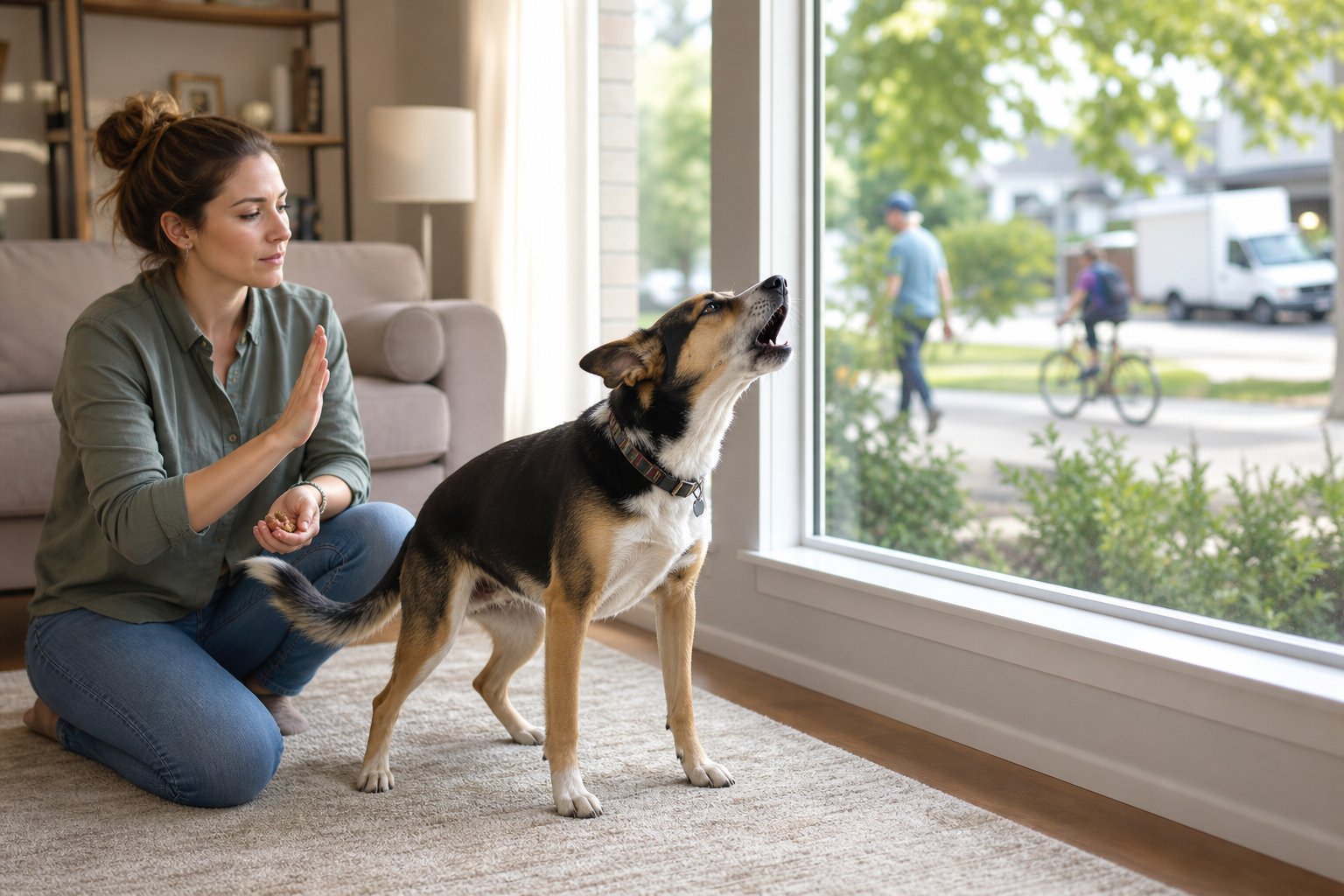
Barking is normal dog communication, but the amount, timing, and cause of it determine whether it counts as a problem. Knowing what sets your dog off is the first step toward changing the behavior.
Normal Communication Versus Problem Barking
Dogs bark to alert you, greet visitors, ask for something, or play. A few barks at a knock on the door is typical. That’s your dog doing its job.
Problem barking looks different. It goes on long after the trigger is gone, happens at odd hours, or starts with almost no trigger at all.
Watch for these signs your dog’s barking has crossed the line:
- Duration: Barking continues for several minutes or more after the cause has passed
- Frequency: It happens many times a day, most days
- Intensity: Your dog seems frantic, pacing, or unable to settle
- Timing: Barking wakes the household at 2 a.m. with no clear reason
Breed matters too. Beagles, terriers, and some herding dogs are naturally more vocal than a Basset Hound or Greyhound. Compare your dog to its own baseline, not to a neighbor’s quiet dog.
Common Triggers in Everyday Life
Most excessive barking traces back to a handful of causes. Once you spot the pattern, you can pick the right fix.
| Trigger | What It Looks Like |
|---|---|
| Territorial alerts | Barking at the mail carrier, delivery trucks, or people walking past a window |
| Boredom | Long stretches of barking when left alone with nothing to do |
| Separation anxiety | Barking or howling that starts within minutes of you leaving, often with drooling or destruction |
| Attention-seeking | Barking directly at you for food, play, or to be let outside |
| Excitement | Barking during play, before walks, or when guests arrive |
| Fear | Barking at thunder, fireworks, or unfamiliar dogs, often with a tucked tail |
Medical causes deserve a mention. Pain, hearing loss, and canine cognitive dysfunction in older dogs can all cause new or increased vocalizing.
If your dog’s barking changed suddenly and you can’t find a trigger, a vet visit should come before any training plan.
Identifying the Root Cause

Many pet owners wonder why their dog barks at everything they see or hear. Understanding the causes can help you address the issue effectively.
Barking is a symptom, not the problem itself. Before you can reduce it, you need to know what your dog is reacting to — fear, territory, boredom, or a physical issue that changed how they experience the world.
Fear, Anxiety, and Reactivity
Fearful barking usually comes with body language you can spot. Look for a tucked tail, ears pinned back, weight shifted backward, or a dog who barks and then retreats a few steps.
The bark itself often sounds higher pitched and comes in rapid bursts. Dogs who bark from fear are trying to increase distance between themselves and whatever worries them.
Common triggers include:
- Strangers approaching the house or walking past
- Other dogs on leash, especially at close range
- Loud noises like fireworks, construction, or garbage trucks
- Unfamiliar objects such as umbrellas, bikes, or luggage
Separation anxiety looks different. That barking starts within 10 to 30 minutes of you leaving and often comes with pacing, drooling, or damage near doors and windows.
Territorial and Alert Responses
Territorial barking has a clear pattern: it starts when something crosses a boundary and stops when the trigger leaves. Your dog is announcing an arrival, not asking for help.
This bark tends to be deeper and more rhythmic. The dog usually moves toward the trigger — the window, the fence line, the front door — with an upright, forward-leaning posture.
Windows and fences make this worse. A dog who can see the sidewalk all day gets dozens of practice sessions in barking, and each one that “works” (the mail carrier leaves) reinforces the habit.
Watch the timing, too. If barking clusters around delivery hours or when neighbors come home from work, you’re dealing with alert behavior rather than anxiety.
Boredom, Frustration, and Attention Seeking
Under-exercised dogs bark because they have energy with nowhere to go. This barking often sounds repetitive and monotonous, and it happens during quiet stretches of the day rather than in response to a specific trigger.
Frustration barking shows up when your dog wants something they can’t reach — a squirrel, another dog across the street, or a toy under the couch.
Attention seeking is easier to test. Note whether the barking stops the moment you make eye contact, speak, or move toward your dog.
| Type | When it happens | What stops it |
|---|---|---|
| Boredom | Long idle periods, alone or with you | Physical and mental activity |
| Frustration | Blocked access to something wanted | Removing the barrier or redirecting |
| Attention seeking | When you’re present but occupied | Any response from you |
If you’ve been giving treats, talking, or petting to quiet the barking, you may have taught your dog that barking works.
Medical and Age-Related Factors
A sudden change in barking with no change in environment deserves a vet visit. Pain makes dogs less tolerant of handling, noise, and other animals, and that lower threshold shows up as more barking.
Hearing loss is a common cause in older dogs. When dogs can’t gauge their own volume or hear a person approaching, they may bark longer and more loudly than before.
Canine cognitive dysfunction affects senior dogs and often produces barking at night, barking at walls or corners, and general disorientation.
Also consider:
- Vision loss, which makes ordinary shapes and movement seem threatening
- Thyroid problems, which can change behavior and irritability
- New medications, which sometimes affect mood or arousal
Bring specifics to your appointment: when the barking started, what time of day it happens, and whether anything else changed at the same time.
Immediate Management Strategies

Training takes weeks, but you can cut down barking today by changing what your dog sees, hears, and does at home. Blocking the view from windows, lowering household noise, and giving your dog a safe spot away from the action all help right away.
Reducing Exposure to Triggers
Most barking starts with something your dog notices. Take away the trigger, and the barking often drops fast.
Here are quick fixes that work:
- Cover the windows. Frosted window film or a static-cling privacy film on the lower half of the glass blocks the sidewalk view but still lets light in.
- Close the blinds during busy times, like school pickup or evening dog walks.
- Move furniture away from windows so your dog can’t perch and scan the street.
- Block off the front room with a baby gate if that’s your dog’s lookout spot.
- Skip the front yard for potty breaks if passing dogs set off barking. Use the back yard instead.
If your dog barks at the mail carrier every day, ask your delivery driver to leave packages at a side door. Small changes to a daily routine can stop a barking habit from getting stronger.
Creating a Calm Home Environment
Noise you barely notice can keep your dog on alert all day.
Try a fan, an air purifier, or a white noise machine near the door or window your dog guards. Steady background sound covers footsteps, car doors, and voices outside.
Soft music or a talk radio station at low volume works too. Keep the volume just loud enough to blur outside noise, not loud enough to add stress.
Exercise matters as well. A tired dog reacts less. Two solid walks a day, plus a sniffing game or a food puzzle, burn off energy that would otherwise go into barking.
Feed meals from a snuffle mat or lick mat instead of a bowl. Chewing and licking lower arousal and give your dog something to do besides watch the window.
Using Safe Confinement and Distance
Distance is your friend. The farther your dog is from the trigger, the quieter they usually get.
Set up a comfortable space in a back room or interior hallway, away from the front door and street-facing windows. Add a bed, water, a chew toy, and something that smells like you.
| Setup | Best for |
|---|---|
| Crate with a cover | Dogs already crate trained and relaxed inside |
| Baby gate in a hallway | Dogs who panic in closed spaces |
| Back bedroom with door closed | Delivery times, guests arriving, yard work next door |
| Exercise pen in a quiet corner | Puppies and young dogs |
Never use confinement as punishment. Feed meals there and give treats there so the space feels good.
Build up slowly. Start with a few minutes while you’re home, then add time. If your dog scratches, drools, or barks nonstop when confined, stop and talk to a trainer or your vet, since that can point to separation anxiety rather than simple trigger barking.
Training Calm, Alternative Behaviors

Yelling at a barking dog rarely works, because your dog can’t guess what you want instead. The fix is teaching a specific behavior that replaces barking, then paying your dog well for choosing it.
Teaching a Quiet Cue
Start when your dog is already barking at something mild, like a knock on the wall.
Say “quiet” once in a normal voice. The moment your dog stops barking, even for one second, mark it with “yes” and hand over a treat.
Don’t repeat the word over and over. If you say “quiet, quiet, quiet,” the cue loses meaning.
As your dog catches on, wait longer before you pay. Two seconds of silence, then five, then ten.
A few things that help:
- Use high-value treats like chicken or cheese for this specific exercise
- Practice in a quiet room first, then add real triggers
- Keep sessions to 3–5 minutes so your dog stays interested
If your dog barks again right after the treat, you moved too fast. Go back to shorter silences.
Rewarding Silence and Relaxation
Most owners only pay attention to their dog when the noise starts. That teaches your dog that barking gets results.
Flip it. Keep a jar of treats near the window or front door, and drop one to your dog whenever they’re lying quietly.
A “go to place” behavior gives your dog a clear job. Pick a mat or raised bed, lure your dog onto it, and reward.
Then start sending them there when the doorbell rings or a delivery truck pulls up. Over time, that spot becomes where your dog goes to settle.
Reward the position of relaxation, not just the stillness. A dog with a hip rolled to one side and a loose jaw is genuinely calm.
Building Focus Around Distractions
A dog who can look at you on cue has an option besides barking.
Teach “watch me” by holding a treat near your eye, saying the cue, and paying for eye contact. Practice indoors until it’s automatic.
Then take it outside at a distance where your dog notices a trigger but isn’t reacting yet.
| Distraction Level | Distance From Trigger | What to Ask For |
|---|---|---|
| Easy | 50+ feet | Eye contact, one treat |
| Medium | 20–30 feet | Eye contact plus a sit |
| Hard | 10 feet | Short heel past the trigger |
Move closer only when your dog succeeds three or four times in a row. Backing up a step isn’t failure, it’s information.
Gradual Desensitization and Counterconditioning
These two methods work together and take the most patience.
Desensitization means exposing your dog to the trigger at such a low level that they don’t react. Counterconditioning means pairing that trigger with something great, so your dog’s feeling about it changes.
For a dog who barks at doorbells, play a doorbell recording at very low volume. Feed treats while it plays, and stop the treats when it stops.
Raise the volume slightly over many sessions. The order matters: trigger first, then food.
If your dog barks, the level was too high. Drop back to where they were comfortable and build up again more slowly.
Expect weeks, not days. Dogs with strong reactions often need a certified trainer to set the right starting point.
Mistakes That Can Make Barking Worse
Some common responses to barking actually teach your dog to bark more. Punishment can raise your dog’s stress level, and mixed messages from different family members can undo weeks of training.
Avoiding Punishment-Based Methods
Yelling at a barking dog rarely works. To your dog, it can sound like you’re joining in.
Shock collars, spray collars, and physical corrections carry bigger risks. They may stop the noise for a moment, but they don’t address why your dog is barking.
A dog barking out of fear who gets punished often becomes more afraid. That fear can turn into growling, lunging, or biting.
There’s another problem: punishment can teach your dog to stay silent about things that worry them. A dog that stops warning you before it snaps is harder to read and less safe around guests.
Better options:
- Reward quiet moments with treats before barking starts
- Teach a “quiet” cue paired with a food reward
- Block the trigger with window film, baby gates, or white noise
- Give your dog something else to do, like a chew or puzzle feeder
Maintaining Consistent Household Responses
If one person ignores barking and another hands over a treat to stop it, your dog learns that barking works about half the time. Behavior that pays off sometimes is the hardest kind to change.
Sit down with everyone in your home and agree on the plan. Write it down if that helps.
| Situation | What everyone should do |
|---|---|
| Dog barks for attention | Turn away, wait for silence, then engage |
| Dog barks at the doorbell | Send to a mat, reward calm behavior |
| Dog barks at the window | Call away, close the blinds, offer a chew |
| Dog is quiet during a trigger | Mark and treat right away |
Guests and dog walkers need the same instructions. Consistency matters more than any single technique you choose.
When to Seek Professional Help
Some barking problems need more than home training. A sudden change in your dog’s barking can point to a medical issue, and long-standing or intense barking often needs a trainer or behavior expert who can watch your dog and build a plan.
Signs That Require Veterinary Evaluation
Book a vet visit if the barking started suddenly and your dog was calm before. Pain, hearing loss, and vision changes can all make a dog bark more.
Watch for these signs along with the barking:
- Barking at nothing, especially in older dogs, which can signal cognitive decline
- Yelping or barking when touched, moved, or getting up
- Limping, stiffness, or trouble with stairs
- Barking at night paired with pacing, confusion, or accidents in the house
- Appetite changes, weight loss, or low energy
- Head shaking, ear scratching, or bumping into things
Dogs over seven years old deserve extra attention. Age-related brain changes, arthritis, and thyroid problems all show up as new vocal habits.
Your vet can rule out physical causes first. That step matters, because training alone will not fix barking driven by pain or illness.
Working With a Qualified Behavior Professional
Consider a professional when barking involves fear, aggression, or panic. Growling, lunging, snapping, or barking that comes with drooling and destruction during your absence all need expert input.
Look for these credentials:
| Credential | What It Means |
|---|---|
| CPDT-KA | Certified Professional Dog Trainer with tested knowledge |
| CBCC-KA | Certified behavior consultant for fear and aggression cases |
| IAABC member | Consultant screened by a behavior organization |
| DACVB | Veterinary behaviorist, a vet with specialty training |
A veterinary behaviorist can prescribe medication when anxiety runs high. Some dogs need that support before training can work.
Ask any trainer what happens if your dog gets it wrong. Skip anyone who relies on shock collars, prong collars, or intimidation, since these methods often increase fear-based barking.
Frequently Asked Questions
Most barking problems come down to a trigger your dog can see or hear, a lack of practice with calm behavior, or a change in health. Below are answers to the questions dog owners ask most, including how to teach a “quiet” cue and what to do when an older dog starts barking out of nowhere.
Why does my dog bark at everything that passes by?
Your dog is most likely guarding territory or reacting to movement. Dogs bark at people, cars, and other animals that cross what they see as their space.
Windows and fences make this worse. Your dog spots a trigger, barks, and the trigger walks away. To your dog, the barking worked.
Boredom plays a role too. A dog that gets little exercise or mental work will find something to bark at just to fill the time.
How can I stop my dog from barking at people, dogs, and noises?
Start by cutting off access to the trigger. Close the blinds, use window film, or move your dog to a room away from the front of the house.
Then change how your dog feels about the trigger. When a person walks by, give a treat before your dog reacts. Repeat this many times so your dog learns that a passerby means food, not danger.
For noises like doorbells or delivery trucks, play a recording at a low volume and pair it with treats. Slowly raise the volume over several sessions.
Also give your dog something else to do. Teaching a dog to go to a mat when the doorbell rings gives them a job that does not involve barking.
What is the most effective training method to reduce excessive barking?
Positive reinforcement paired with desensitization works best for most dogs. You expose your dog to the trigger at a level that does not set them off, then reward calm behavior.
This approach fixes the emotion behind the barking, not just the sound. Punishment, yelling, and shock collars may stop the noise for a moment, but they often raise stress and can make reactivity worse.
Timing matters. Reward your dog the instant they notice the trigger and stay quiet, not after the barking starts.
🧰 THE BARK KIT (snuffle mat, puzzle feeder, white noise)
▸ Snuffle mat – Puzzle feeder – White noise machine
Can I train my dog to stop barking on command?
Yes. The “quiet” cue is straightforward, though it takes repetition.
Here’s one common method:
- Let your dog bark two or three times.
- Say “quiet” once in a calm voice.
- Wait for a pause in the barking, even a one-second break.
- Mark the pause with a word like “yes” and give a treat.
- Slowly ask for longer stretches of silence before you reward.
Some trainers teach “speak” first. If your dog barks on cue, it becomes easier to teach them to stop on cue.
Don’t repeat the word over and over. Saying “quiet, quiet, quiet” teaches your dog to ignore it.
What is the 3-bark rule, and does it work?
The 3-bark rule means you let your dog bark about three times to alert you, then ask for quiet. The idea is that barking at a knock or a strange sound is normal, so you allow a short alert instead of trying to erase it.
It can work well for dogs that bark at doorbells or visitors. You acknowledge the alert, thank your dog, and redirect them.
It’s less useful for barking driven by anxiety or fear. In those cases, the underlying stress needs to be addressed with counterconditioning or help from a professional.
Why has my older dog suddenly started barking more often?
A sudden change in an older dog often points to a health issue. Hearing loss, vision loss, pain, and canine cognitive dysfunction can all increase barking.
A dog losing hearing may bark louder because they can’t judge their own volume. A dog with fading eyesight may bark at shapes they can no longer identify.
Cognitive decline can cause confusion, night pacing, and barking at nothing in particular. Pain from arthritis or dental problems can also make a dog more reactive.
Schedule a vet visit before you start a training plan. Treating the medical cause often reduces the barking on its own.